Simplifying Billing Rules
Company: Camber Health
Role: Sr. Product Designer (sole designer)
Duration: 1 month
Team: 1 engineer
Overview
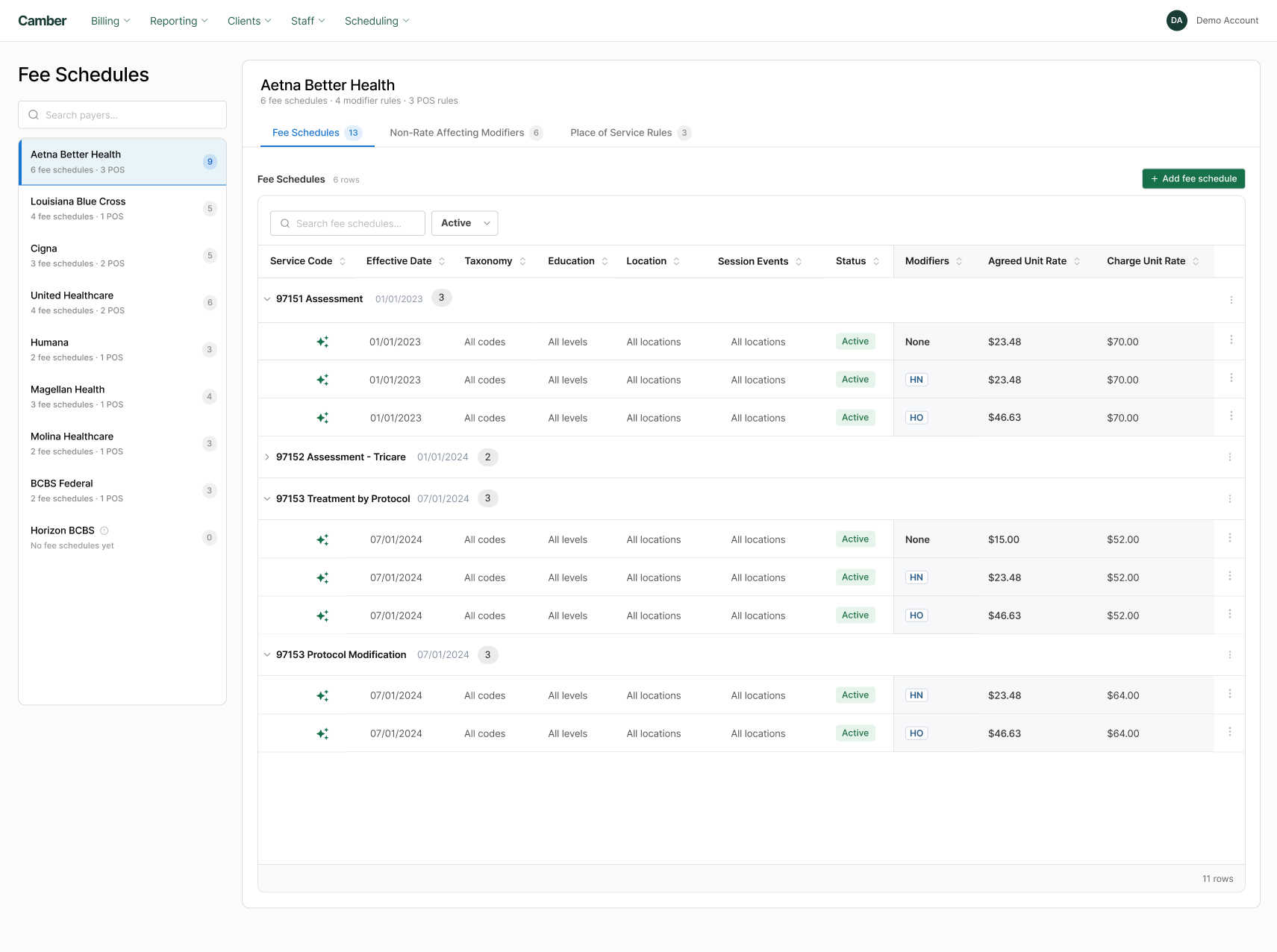
ABA clinics rely on accurate insurance billing configurations to get paid for the services they provide. At Camber, clinics could configure fee schedules to reflect negotiated insurance rates across service codes, with modifiers accounting for additional factors such as provider credentials and education level.
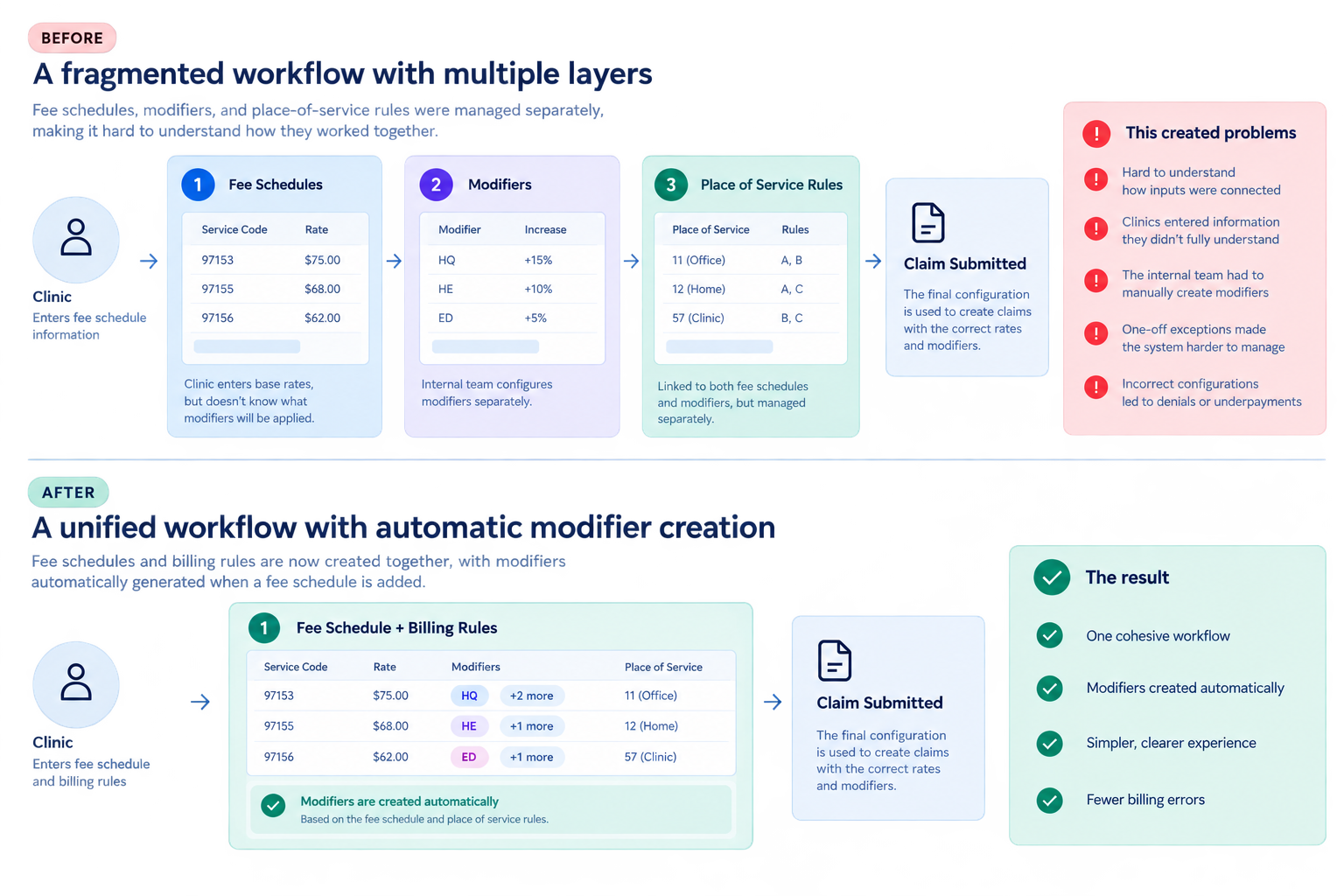
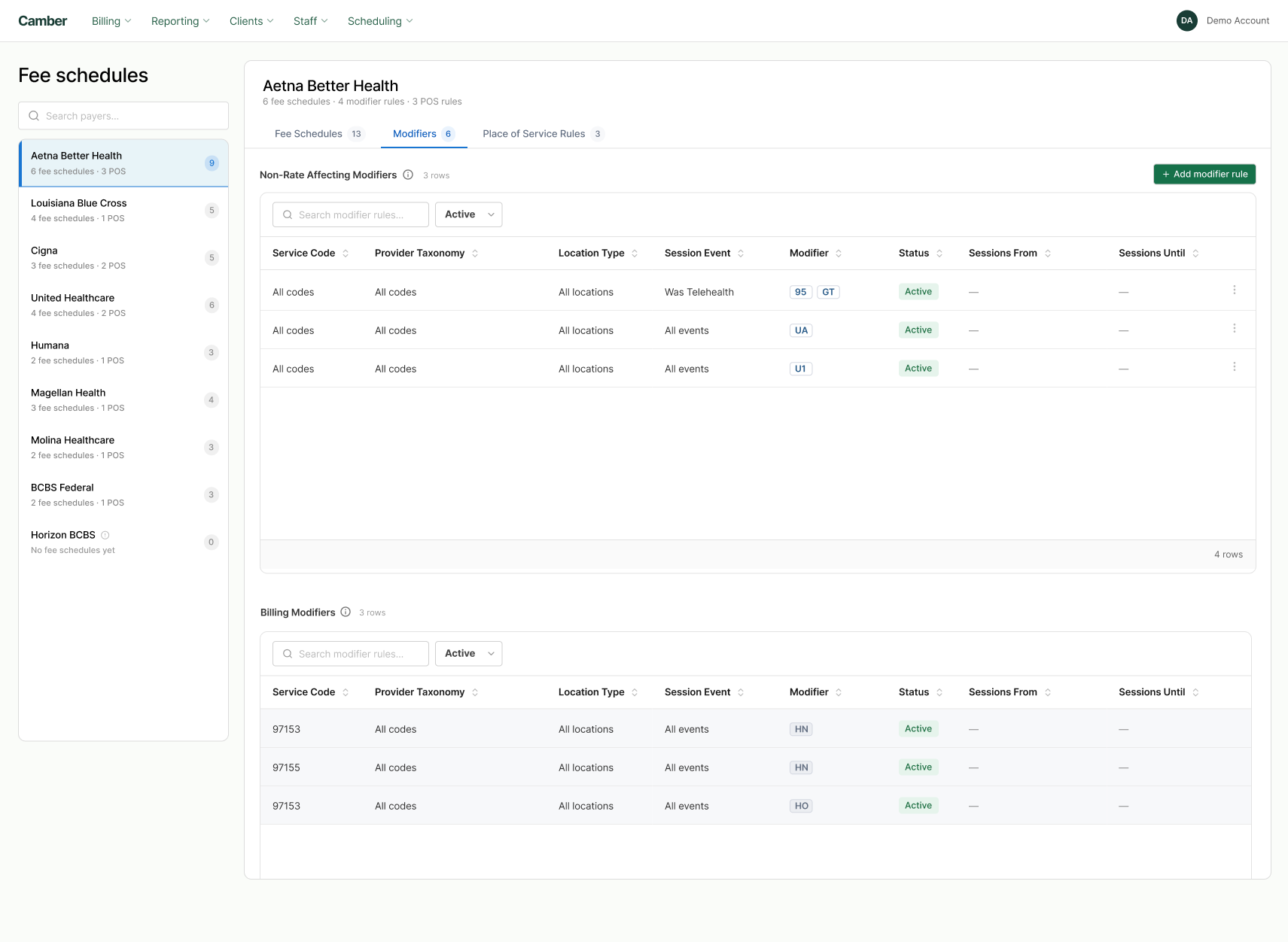
Over time, the system grew increasingly complex. Fee schedules, modifiers, and place-of-service rules were managed across separate but interconnected workflows. As exceptions accumulated, it became difficult for users to understand how their inputs affected the final billing configuration.
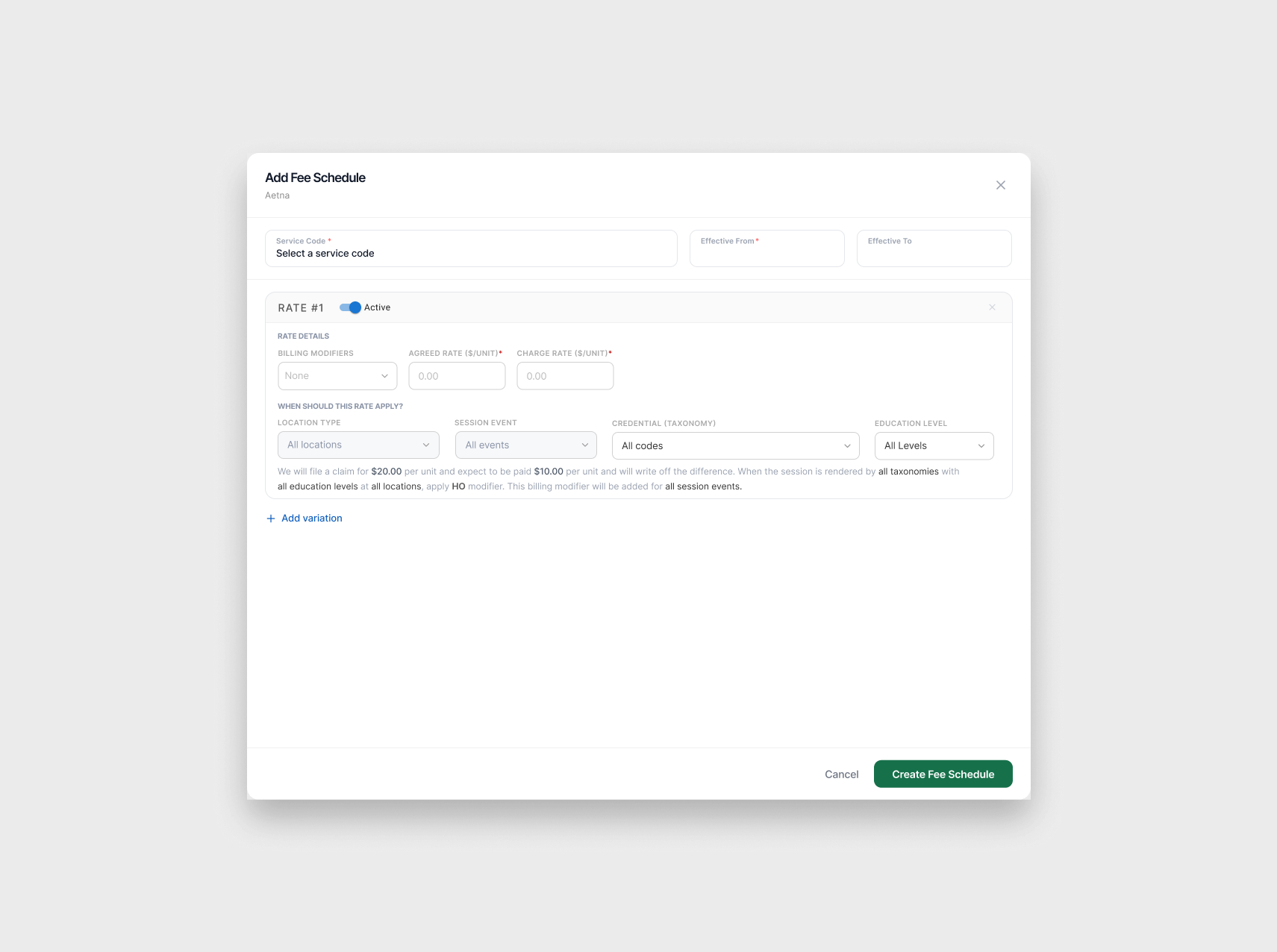
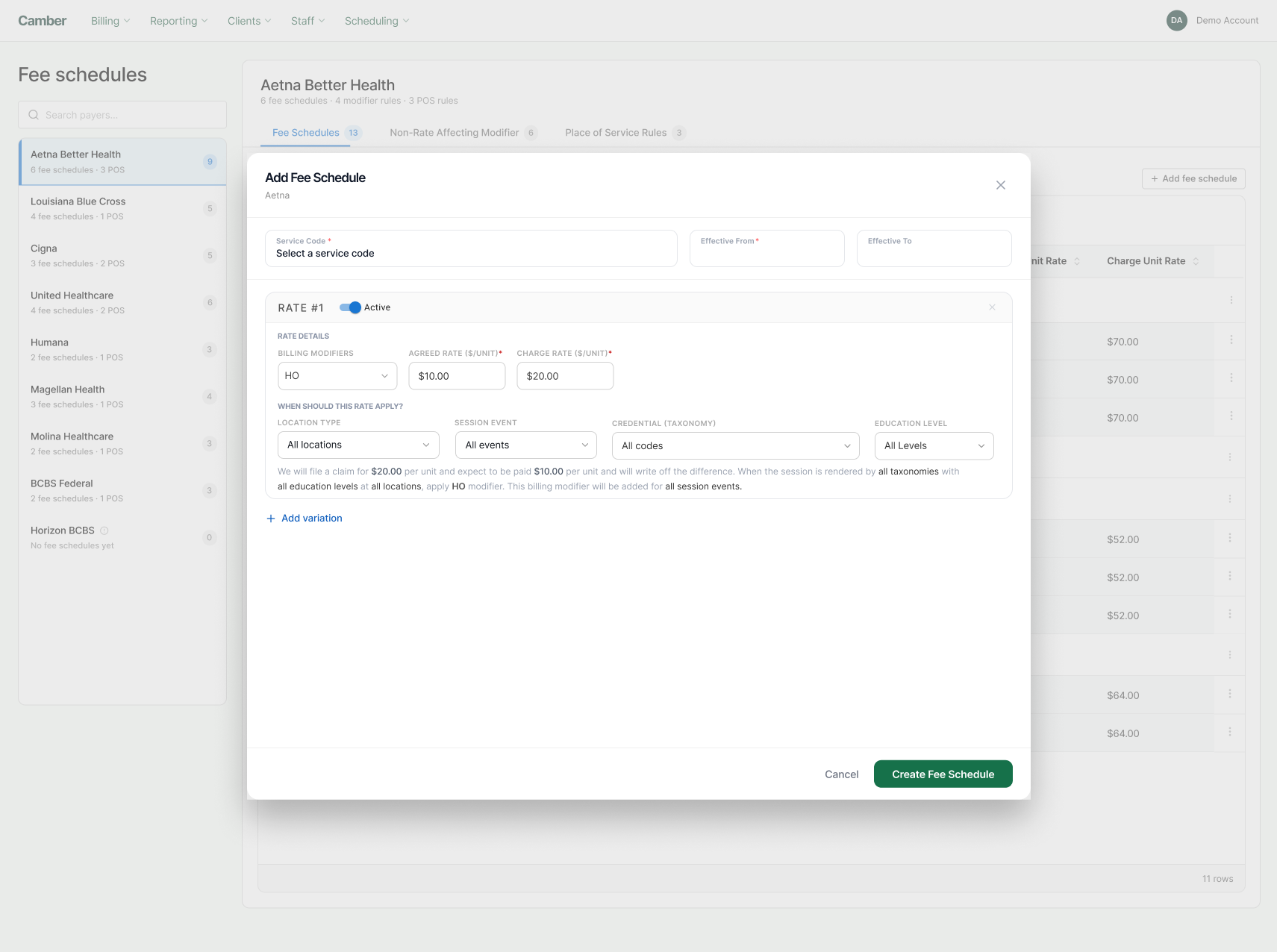
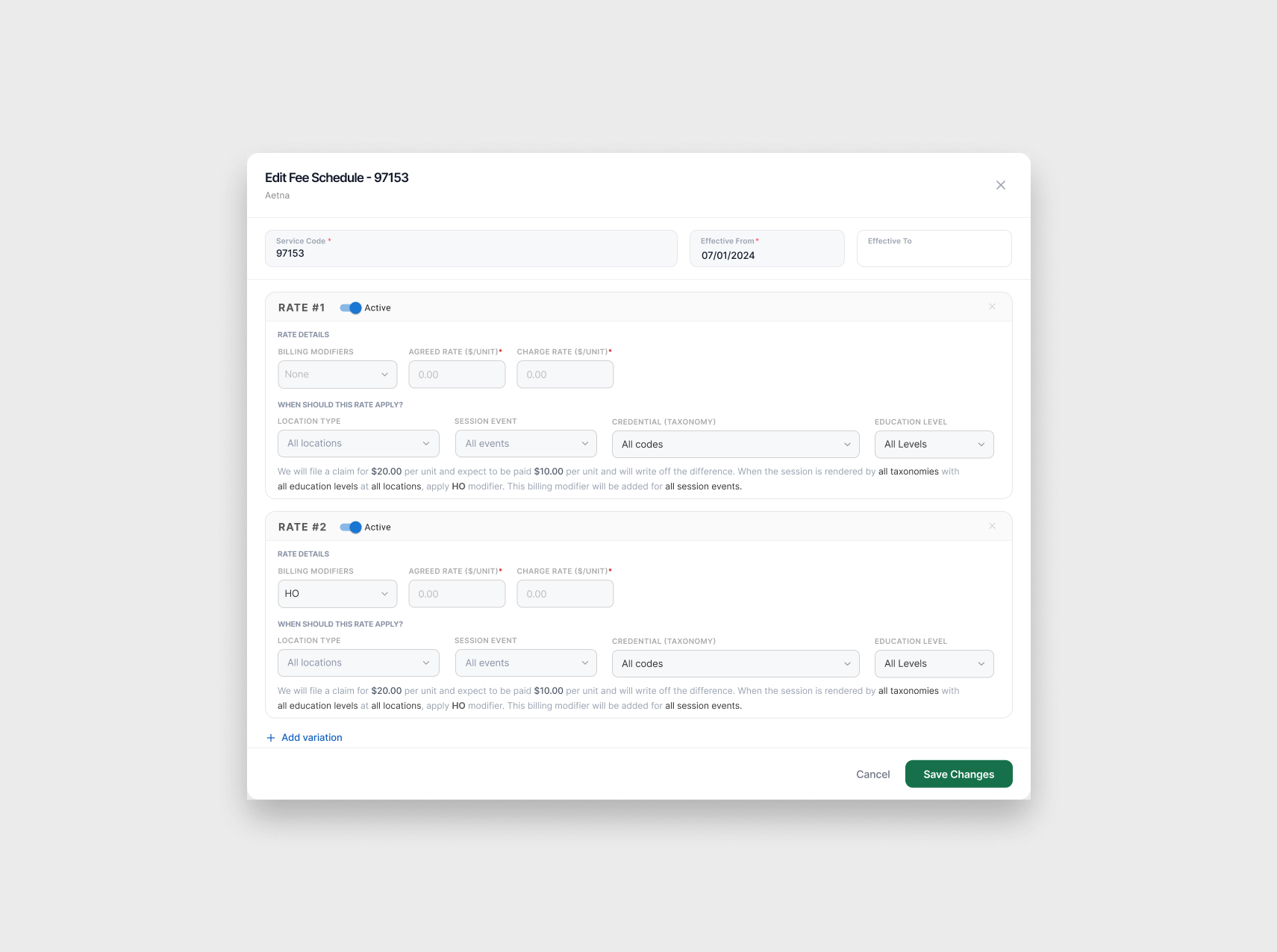
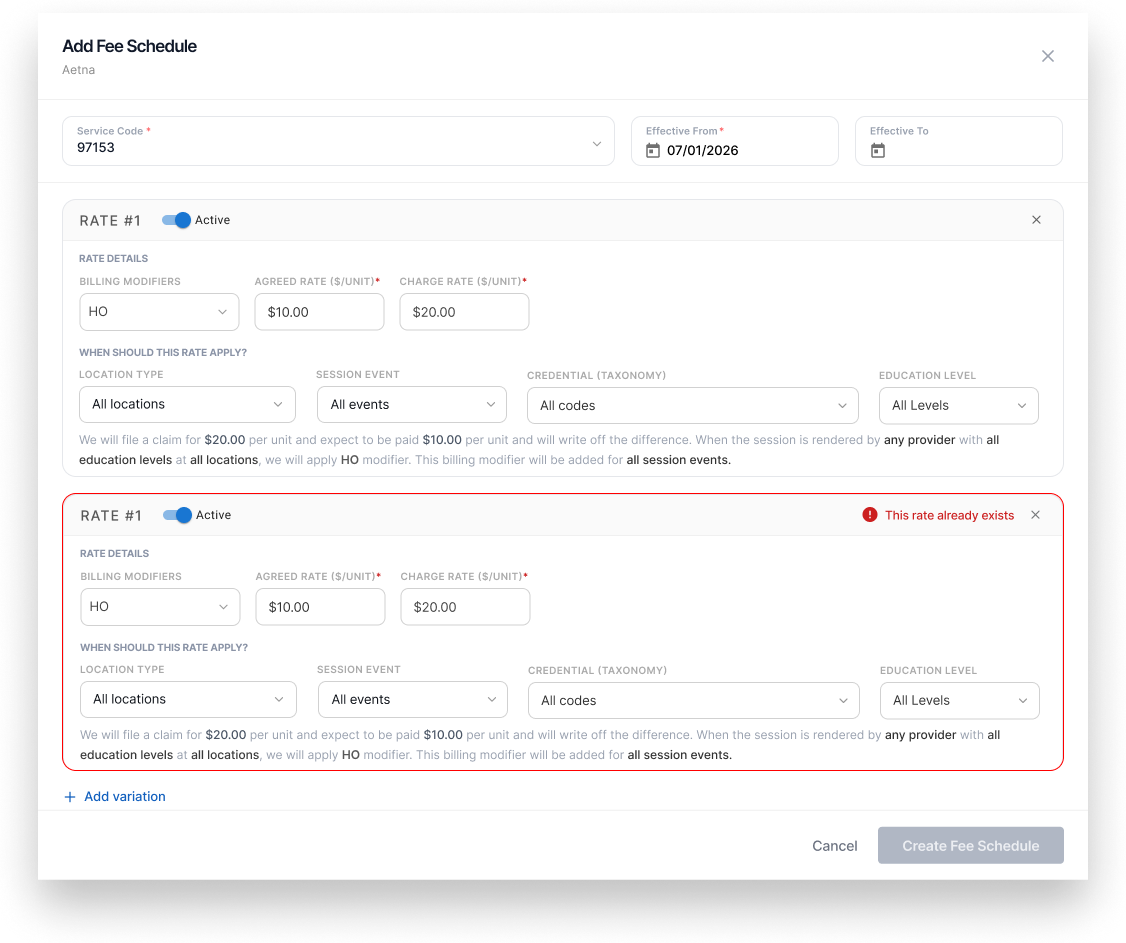
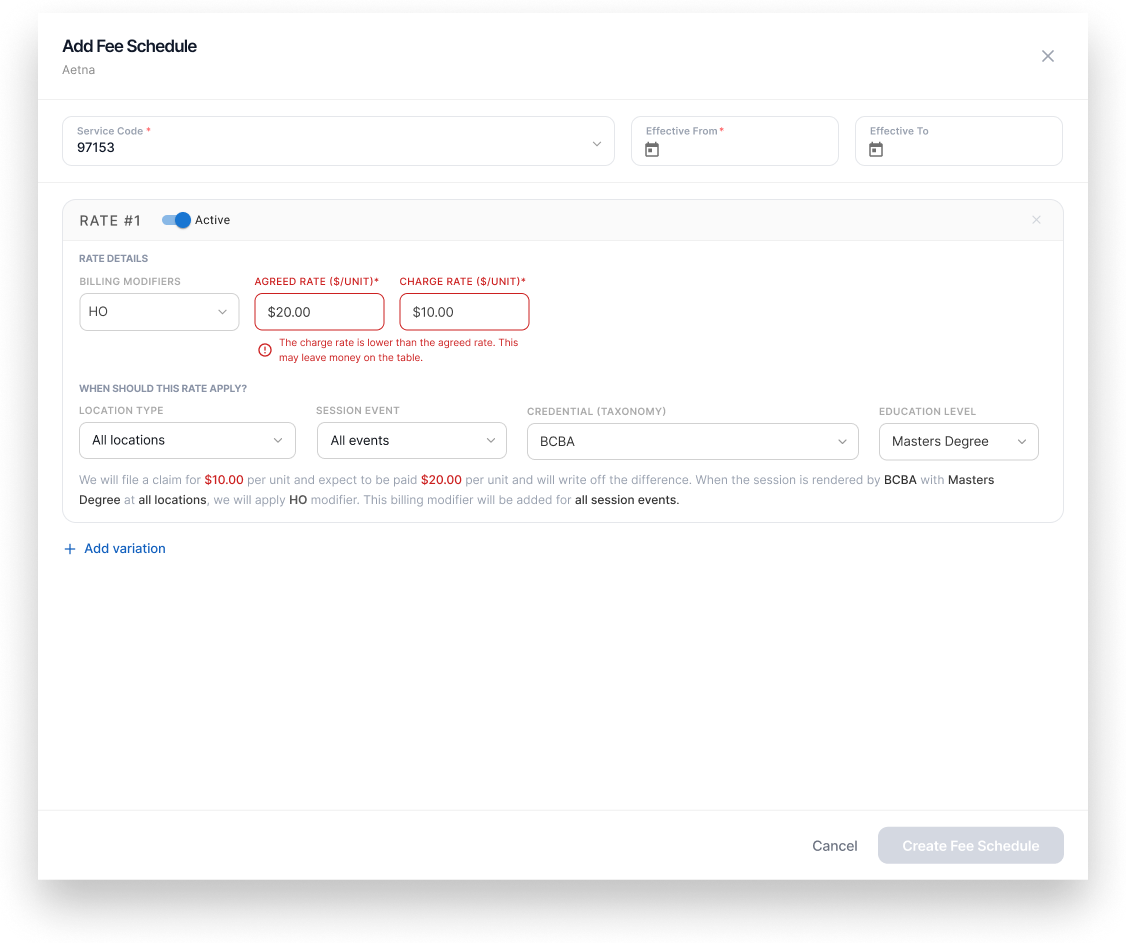
I redesigned the workflow by consolidating fee schedules and billing rules into a single, more cohesive experience. By automatically generating the associated modifiers when a fee schedule was created, we reduced unnecessary configuration work, made the process easier to understand, and helped prevent billing errors that could lead to denied or underpaid claims.
The problem: Flexibility created complexity
The existing system was designed to accommodate a wide range of insurance contracts and billing scenarios. While this flexibility was necessary, it came at the cost of usability and maintainability.
Three interconnected problems emerged:
Fragmented configuration. Fee schedules, modifiers, and place-of-service rules lived in separate areas of the product, requiring users to understand how multiple layers of configuration interacted.
Unclear user responsibility. Clinics were asked to enter fee schedule information without having a clear understanding of how the system would use those inputs. Meanwhile, our internal team handled modifier configuration on their behalf.
Increasing operational overhead. As one-off exceptions accumulated, the system became harder to manage. Incorrect or mismatched configurations could result in claims being submitted with the wrong rates or modifiers, leading to denials, underpayments, and additional manual work.
The result was a system that exposed users to complexity without giving them meaningful control over it.
Discovery: Understanding the work behind the workflow
To understand where the experience was breaking down, I partnered closely with our Customer Experience point person, who regularly handled billing inaccuracies and manually configured modifiers for clinics.
This collaboration helped me understand not just how the product was supposed to work, but how it actually operated day to day.
I also spoke with external users who were experienced with fee schedules and modifiers. Even these users struggled to understand the full implications of the information they were entering into the system.
Two important insights emerged:
The interface reflected the system's internal complexity, not the user's mental model.
Users understood that they needed to configure insurance reimbursement rates. They did not necessarily understand the relationships between fee schedules, modifiers, and place-of-service rules, nor should they have needed to understand every underlying dependency to complete their task.
The workflow asked users to configure information they weren't responsible for maintaining.
Clinics entered the fee schedule information, but our internal team was responsible for setting up the associated modifiers. This created an unnecessary separation between the initial input and the operational work required to make it usable.
The opportunity was to simplify the workflow at its source rather than add more instructions or validation to an already complicated process.
The solution: Bring fee schedules and billing rules together
I redesigned the workflow around the user's primary task: configuring insurance fee schedules accurately and efficiently.
Rather than requiring users to navigate between separate configuration areas, I consolidated fee schedules and billing rules into a unified experience.
Consolidated related workflows
I brought fee schedule creation and billing rule configuration together, reducing the need to navigate between disconnected sections and understand their underlying relationships.
Automated modifier creation
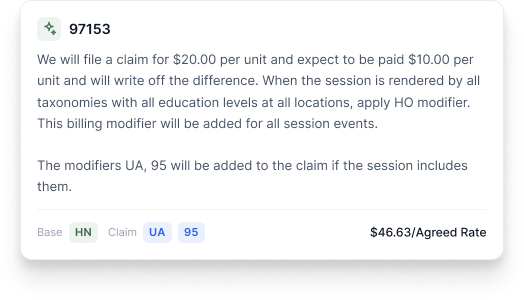
Previously, modifiers were configured separately from fee schedules. In the new workflow, creating a fee schedule automatically generated the associated modifiers, reducing redundant setup and unnecessary manual intervention.
Aligned the experience with actual responsibilities
I designed the workflow around the information clinics were equipped to provide, while reducing their exposure to configuration work handled by our internal team.
This shifted the experience away from asking users to understand the system's implementation and toward helping them complete the task they came to do.
The impact
The redesign addressed both the user-facing complexity and the operational burden behind it.
Reduced manual work: Eliminated the need for the CX team to repeatedly configure associated modifiers as a separate step.
Improved billing reliability: Reduced opportunities for configuration mismatches that could result in incorrect rates or modifiers on claims.
Simplified the user experience: Created a more coherent workflow that better matched how clinics understood and completed fee schedule setup.
Reduced unnecessary complexity: Addressed the underlying workflow fragmentation rather than layering additional exceptions onto the existing system.
The change also created an opportunity to reduce recurring operational work for the CX team, freeing up time that could otherwise be spent resolving billing inaccuracies.
Key takeaway
This project reinforced an important principle in designing complex B2B products: flexibility is only valuable when users can understand and use it effectively.
Instead of exposing every layer of the billing system to the user, I focused on aligning the product with their actual responsibilities and automating the complexity that didn't need to be managed manually.
The result was a simpler workflow designed to support more accurate billing, reduce operational overhead, and make a complex system easier to use.